Wednesday, July 18, 2007

SEALS IN ARCHIVES: PERSEPOLITAN ADMINISTRATORS AND THEIR IMAGES

[This article appeared in The Oriental Institute News & Notes, No. 194 (Summer 2007), and is reproduced here with the kind permission of the Oriental Institute. News & Notes is a quarterly publication, printed for members as one of the privileges of membership in the Oriental Institute]


SEALS IN ARCHIVES: PERSEPOLITAN ADMINISTRATORS AND THEIR IMAGES

by Mark B. Garrison

Presented at the Oriental Institute, in honor of the retirement of Raymond D. Tindel (March 26, 2007)


Archives of clay tablets have been found at a wide variety of sites across the great sweep of what we today call the ancient Near East, or ancient Western Asia. Archives are highly prized owing to the rich textual evidence that they provide on various matters social,political, economic, religious, etc. What is perhaps less well known about archives of clay tablets is that they are often conveyers of visual imagery. In many instances part of the protocols involved in administrative activity was the application of one or more seals across various surfaces of the tablets. These seal impressions functioned administratively on a variety of levels, acting as markers of witnesses to the transactions,identifiers of personnel/offices involved,tokens of authority and security, etc. Some “archives” consist in fact solely of uninscribed clay artifacts that carry seal impressions.


Persepolis Fortification tablets in situ


Seals in ancient Western Asia consisted of two types, cylinders and stamps. Since their invention in the late fourth millennium B.C., cylinder seals were by far the preferred medium in ancient Iran and Iraq. In the first millennium B.C., stamp seals re-appeared and were used contemporaneously with cylinder seals. When cylinder and stamps were applied to the still-moist tablets, the imagery, carved on the reverse in the actual seal matrix, would appear in the positive on the surfaces of those tablets. One of the interesting aspects about seals is that the seal user created imagery through the application of his/her carved glyptic artifact. While some seal users may have understood that imagery in a very practical manner, i.e., a signature, it is clear that many seal users prized the often virtuosic carving and must have delighted in the potential imagery that lay literally at their fingertips.

The importance of glyptic imagery has long been recognized. Indeed, seals are the most commonly occurring artifact that carries visual imagery in the archaeological record of the ancient Near East, surviving by the tens of thousands. As such, seal images have been studied since the beginnings of modern archaeological expeditions in the nineteenth century.

It is a curious aspect of glyptic imagery that it survives in two distinct forms: as an actual seal artifact (usually of stone,but sometimes of clay, bone, metal, shell, etc.), and as an impression in clay. It is exceptionally rare to have both an ancient seal and an ancient impression of it. This may be simply the result of archaeological serendipity, or it may reflect real patterns of human behavior. That is, seals that were used as administrative markers may have been different from those that were used as items of personal adornment and/or amulets; thus, the two types of seals may survive in the archaeological record differently owing to different patterns of use and deposition.


Cylinder seal with modern impression. OIM A25308


Cylinder seals can be manipulated in various ways to provide oftentimes strikingly beautiful modern impressions. Indeed, these seals have to be impressed in some type of modern sealing medium in order for us to study their visual imagery since the carved surface of the cylindrical piece of stone is often difficult, if not impossible, to read. By contrast, seal impressions almost never preserve the full scene and are often difficult to see. In many archives a seal will be applied to more than one clay artifact, meaning that all impressions of that seal must be surveyed and then a collated composite image generated. For these reasons, even today, surveys of the glyptic arts focus almost exclusively on modern impressions of ancient seals, rather than impressions of seals from archives.

It is a sad fact that the great bulk of these seals do not have an excavated provenance. Because of their small size and often beautiful carving, seals have long been highly prized by collectors. The resulting loss of contextual information is a devastating blow to our research endeavors. While the images on these unprovenanced seals may be beautiful, they float in time and space; serious questions of authenticity are often part of the calculus, especially with a seal image that does not fit the canon as traditionally defined. A traditional venue of the publication of glyptic imagery in fact is the catalogue of seals now found in museum and private collections. The scale of the problem of provenance may be seen in the recently published volume six of the British Museum series (Catalogue of the Western Asiatic Seals in the British Museum: Cylinder Seals 6: Pre-Achaemenid and Achaemenid Periods, by Parvine H. Merrillees). Of the ninety-two seals in volume six, only three seals have an excavated provenance.


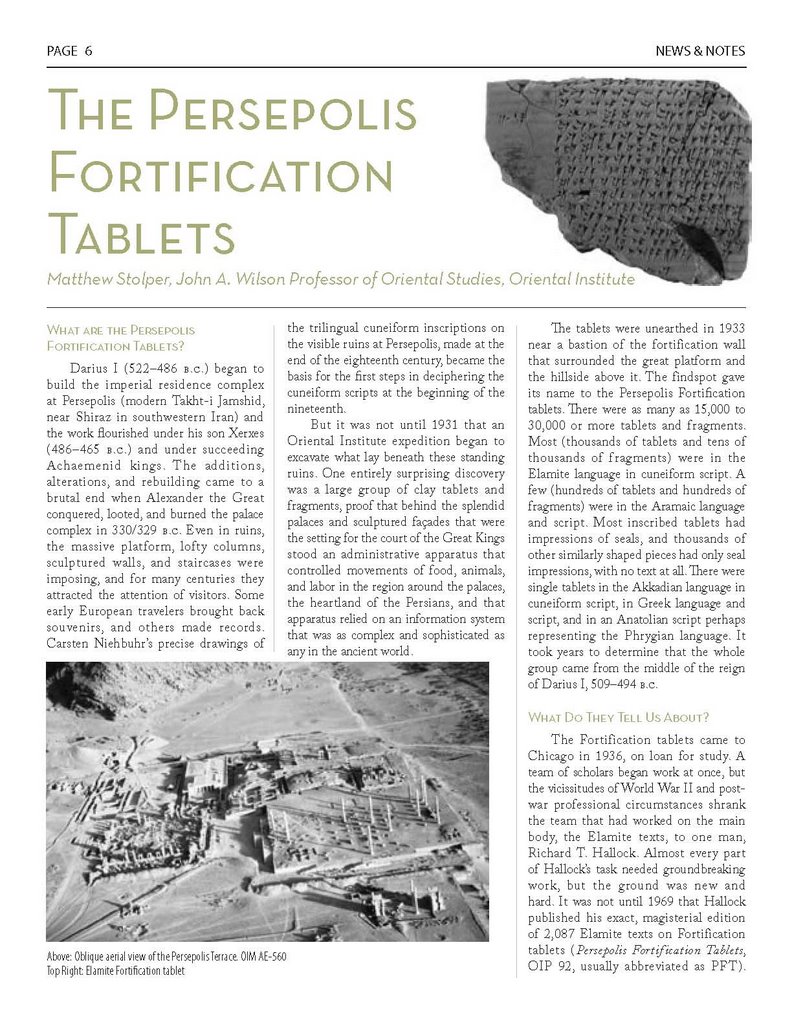
Aerial photograph of the Persepolis terrace; the Fortification archive was discovered in chambers of the fortification wall visible at upper left in the photograph, where the wall abuts the mountain


By contrast, seals preserved as impressions on clay artifacts within the context of archives have less often attracted the attention of collectors (there are, nevertheless, thousands of clay tablets of unknown archaeological provenance in museum and private collections around the world). We are especially fortunate to have many large archives of sealed tablets discovered through controlled archaeological excavations. When we have a seal preserved as an impression on a tablet, we are seeing the imagery in its functional context. That functional context (i.e., the surface of a tablet) is enhanced by the fact that the tablet is related to other tablets via the archival context. The seal impression is thus related via function to other seal impressions in that archive. That archive, moreover, can almost always be specifically located in time and space. Seal images preserved as impressions in archives thus constitute one of the more remarkable contexts for the study of the visual imagery of the ancient world.

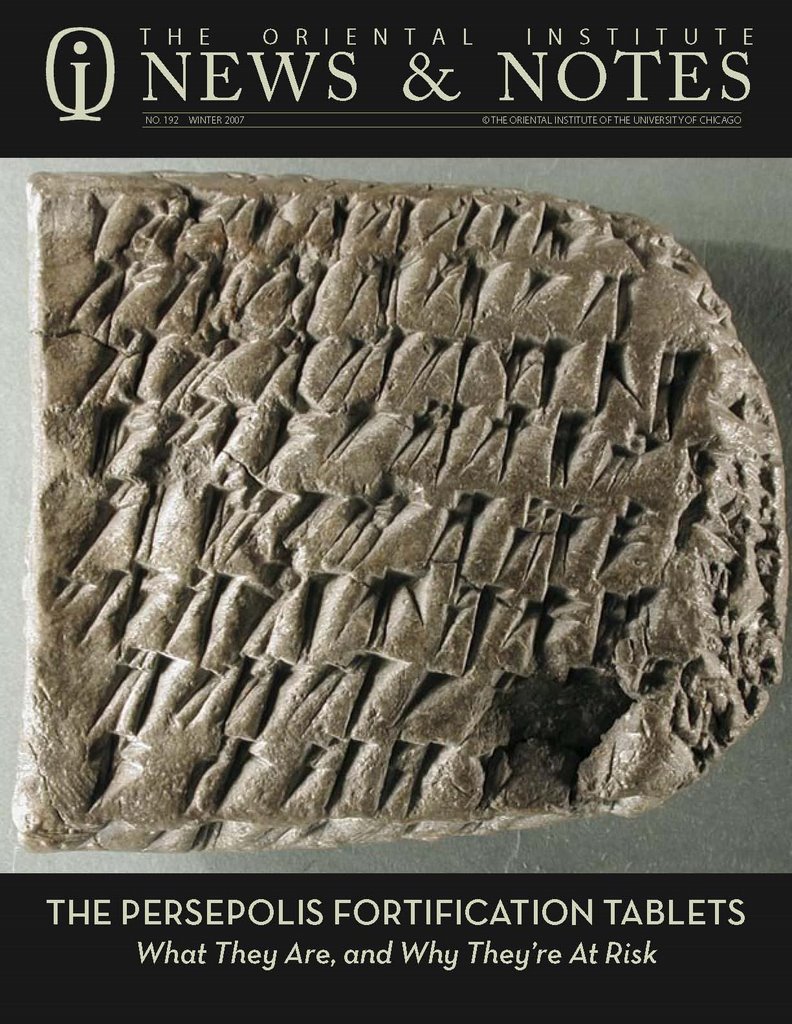
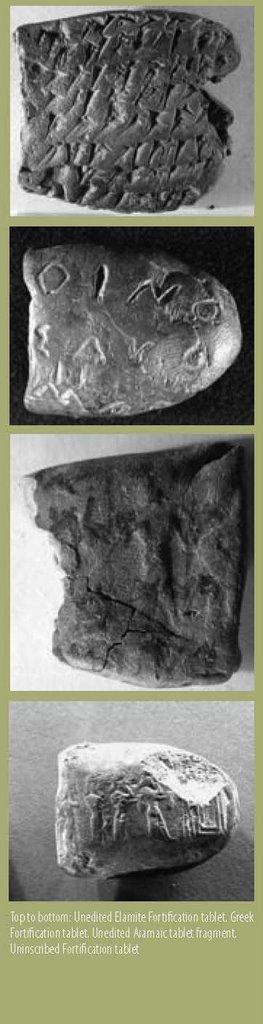
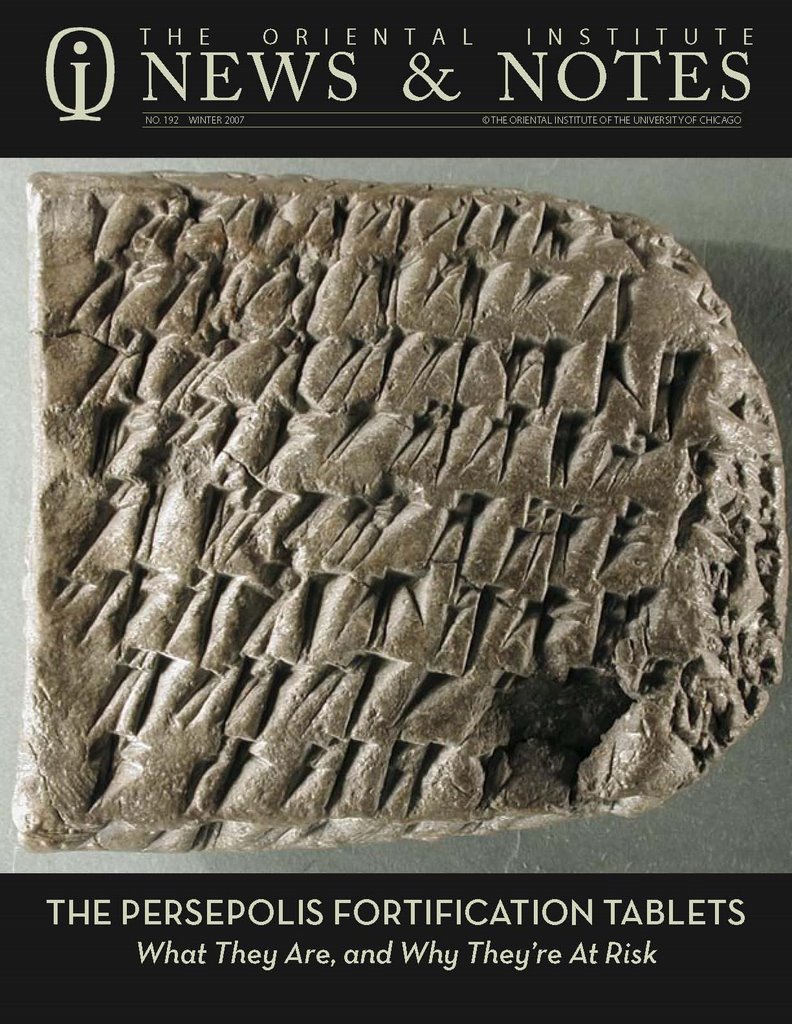
The richness of this evidence and its potential for providing unique insights into the lived human experience/interac-tion with images may be glimpsed in a large archive of administrative documents currently at the Oriental Institute on loan from the Iranian government. This archive is known as the Persepolis Fortification archive. The Persepolis Fortification archive was found in chambers of the northern fortification at Persepolis (whence the name of the archive) in 1933 by a team from the Oriental Institute. The particulars of the archive and its importance were well articulated by M. W. Stolper in the Winter 2007 edition of News & Notes. In brief, the archive represents the administration of a food rationing system that covered an amorphous area consisting of the environs of Persepolis (Parsha), Pasargadae (Batrakatsh), and Shiraz (Tirazzish) and a broad(?) expanse to the northwest along the royal road to Susa. Date formulae preserved in many texts date the archive to years 13–28 (509–493 B.C.), in the reign of Darius I. There are three major components of the archive: tablets that carry Achaemenid Elamite inscriptions in cuneiform and, very often but not always,impressions of seals; tablets that carry Aramaic inscriptions in ink (and/or incised) and, very often but not always, seal impressions; and tablets that carry only seal impressions (what are designated as the uninscribed tablets). The exact number of tablets and fragments is not known, but recent work by Stolper places the tablet count at approximately 15,000–18,000 distinct documents in toto. That is a huge number of artifacts, constituting one of the largest archives to have survived from ancient Western Asia.

The seal images are the only aspect of this administrative system that can be documented across all three components of the archive: Elamite tablets, Aramaic tablets, and uninscribed tablets. The seals applied to the tablets represent the officials and offices delivering and receiving commodities,and the officials and offices responsible for overarching administrative accounting and oversight. Just as there are many tablets, so, too, there are many seals preserved in the archive. On the 2,087 Elamite tablets published by R. T. Hallock in 1969, approximately1,148 different seals can be recognized (we distinguish seals preserved on the Elamite tablets with the siglum PFS). The first volume of the publication of the seal s preserved on the PF tablets has now been published: M. B. Garrison and M. C. Root, Seals on the Persepolis Fortification Tablets, Volume 1: Images of Heroic Encounter (Oriental Institute Publications 117; Chicago: The Oriental Institute, 2001). From preliminary research by E. Dusinberre on the seals applied to the Aramaic documents and by the author on the unpublished Elamite tablets and the uninscribed tablets, there are probably at a minimum another 1,000–1,500 seals.

We have thus preserved in the Fortification archive one of the most densely concentrated collections of visual imagery from the whole of ancient Western Asia and the Mediterranean worlds. Thinking for a moment about the multi-layered contexts, this imagery is closely circumscribed in place (the environs of Persepolis and an area extending to the north and west), time (509–493 B.C.) and function (all the images are being used by officials/offices to seal tablets in the archive). Each of these some 2,000 images is thus linked to all other images in a most intimate and direct way. These images are also objects actively in use by administrators, thus linked to a specific type of activity by specific people. Those individuals, moreover, run the social gamut from lowly workers to the imperial family. The social position and administrative rank of many of these individuals are, furthermore, fairly well known. These images are also linked in time and place with the massive construction activities associated with the building and ornamenting of Persepolis and rock-cut tomb of Darius at Naqsh-e Rustam. Finally, this particular time and place happen to be exceptionally critical, marking the initiation of administrative, political, social, and ideological programs associated with Darius’ consolidation of an empire the scale of which the world had never seen.


Photo of PFS 9*. Drawing and photo by Mark Garrison


By examining, for example, how individuals select and use imagery, we may pursue in these seal images a social history of art that in most other times and places would be an impossibility. One way that we may explore the richness of the multilayered contexts of the Persepolitan seal images is via a phenomenon that I have called “replacement seals.” In numerous instances we are able to track an individual’s replacement of one seal by another. Tracking this type of phenomenon in and of itself would of course be next to impossible with any glyptic artifact found outside of an archival context. Most of the time at Persepolis the adoption of a new seal goes unmentioned in the textual record. In one now-famous case involving the chief administrator of the archive, Parnaka, probably the uncle of Darius, two Elamite texts (PF 2067 and PF 2068) specifically note the replacement of the earlier seal, PFS 9* (Cat.No. 288) with the new seal, PFS 16* (Cat.No. 22): “also, the seal that formerly (was) mine has been replaced — now this seal (is) mine that has been applied to this tablet” (PF 2067).

Parnaka’s right-hand man, the second in command of the archive, Zishshawish, also replaced his earlier seal, PFS 83*, with a new seal, PFS 11*. Zishshawish is the Elamite form of the Old Persian name *Ciça-vahu- “of good lineage.” His two seals provide an especially interesting case of the replacement of seals concerning an individual at the very highest levels of the Persepolitan administration. As indicative of his high administrative rank, Zishshawish receives very high food rations, issues letter orders, employs scribes, and never needs a counterseal on his transactions.

Based on the preserved texts, Zishshawish can be documented using his first seal, PFS 83*, between May/June 507 B.C. and November/December 504 B.C. The seal is a unique and intriguing design. Two figural compositions constitute the major elements of the design field; a winged bovine with suckling calf, and a four-winged human headed-bull supporting a winged disc. An Aramaic inscription along with the lower three prongs of a star remain in the upper field.

If preserved as an unprovenanced artifact in a museum, this seal would probably be classified as an Assyrian product. Certainly, in comparison to the conventional understanding of how Achaemenid glyptic ought to appear, an understanding built almost exclusively upon unprovenanced artifacts, the imagery, iconography and style of carving of PFS 83* certainly do not seem “Achaemenid.” Several features of its design are traditionally associated with Assyrian art. For example, the cow and calf motif was especially popular in Assyrian and Syrian glyptic, ivory carving and metalwork of the early first millennium B.C. So, too, the bull-man in the form of an atlantid, often associated with a winged ring/disk or the half-figure in the winged ring/disk, was very popular in Assyrian glyptic. PFS 83* is not, however,an unprovenanced object. Embedded in a pool of imagery owing to its archival context, we can see that its carving style is completely at home within the seals from the Fortification archive.


PFS 16*. Drawing and photo by Mark Garrison


Lastly, the Aramaic inscription on PFS 83* is quite at home within a Persepolitan context. Only the first word in what appears to have been a one line inscription, enclosed in a panel, is preserved: HTM…, “Seal (of ) …”. The preservation of the vertical edge for a panel at left would seem to indicate that there may have been as many as four or five more letters in the line. One assumes that the missing section of the inscription contained a personal name. Inscribed seals are fairly rare in the archive, less than 10% of the seals carry inscriptions, and the majority of those inscriptions are in Elamite. There is, however, a substantial corpus of seals inscribed in Aramaic, and the formula “Seal of PN” is a common one among those seals. Indeed, it is interesting to note that Parnaka also uses Aramaic for the inscriptions on both of his seals.

PFS 83* thus may be related in style,imagery and inscription to other seals in the archive. In general, the seal takes its place as one example among hundreds of Persepolitan seals that exhibit archaizing imagery and style that are deeply indebted to Assyrian models. Nevertheless, it is clear that this seal is a very special one. The scene of the cow and calf is unique among the seals studied to date in the archive. The Aramaic inscription also marks the seal as special; the combination of the placement of the inscription in the upper field and its enclosure within a panel cannot be paralleled in any other seal studied to date in the archive. Several characteristics thus point to this seal being a commissioned piece. This ought not to surprise us, given the exceptionally high administrative rank of Zishshawish.


Photo of PFS 83*. Drawing and photo by Mark Garrison


On a tablet dated to December 503 B.c./January 502 B.C., Zishshawish for the first time uses his new seal, PFS 11*. He continued to use this seal until Febru-ary/March 496 B.C. Whether the approximately one year hiatus between his last use of PFS 83* and his first use of PFS 11* is real, or simply due to accident of record survival, cannot be determined.

PFS 11* is a magnificent seal, one of the great masterpieces of glyptic carving from the Fortification archive. The scene consists of a central “altar” above which floats a half-figure in a winged disk; to either side of the altar is disposed a crowned figure in Persian court dress. This central scene is then flanked by date palms followed by a paneled, trilingual (Old Persian, Elamite, and Babylonian) royal-name inscription in the terminal field.

Unlike PFS 83*, PFS 11* conforms to our conventional understanding of how Achaemenid glyptic ought to appear, in style, iconography, and composition. The figures wear the Persian court robe and the dentate crown that are so often associated with aspects of Achaemenid imperial imagery. The scene is relatively rare, but,nonetheless, one well known from unprovenanced glyptic examples.

Like PFS 83*, PFS 11* is also a very special glyptic product. The seal is one of four seals from the archive that carry the standard royal-name inscription of Darius. None of these seals belonged to Darius; all were used by high-ranking officials/offices. Of course, without its archival context, we would have no idea that the seal in fact belongs to Zishshawish, and, I suspect, there would be speculation that this was in fact the personal seal of the king. The scene of two figures flanking an “altar” is rare in the archive; I know of only four other examples in the seals studied to date. So, too, the carving style, what I have called the “Court Style,” is rare in the Fortification archive. The scene, and aspects of its iconography, recall the famous tomb relief of Darius at Naqsh-e Rustam, but the relationship is not as close as one may think at first glance. In fact, in its mirror doubling of the royal figure and its static, idealized composition, PFS 11* provides in many ways a very different statement about the nature of Achaemenid kingship.

Owing to the rich archival context, we may offer some speculation on the nature of the relationships of the two seals of Zi‰‰awi‰ to each other, and what those relationships may say about Zishshawish himself. The two seals provide an in-depth view of patron taste/needs at the very highest levels of the imperial administration at the heart of the empire. The precise social/ad-ministrative/political dynamics that lead to Zishshawish’ initial selection of the imagery on PFS 83*, and then the replacement of that imagery with PFS 11*, are, of course, lost to us. Nevertheless, we may be able to infer some aspects to these processes owing to the rich archival contexts of both Zishshawish the administrator and the seals that he uses.

Both seals, as we have seen, are special artifacts, possessing iconographic, stylistic, and compositional traits that are either rare or unique. Both must be commissioned objects, as one may have expected for an individual of Zishshawish’s administrative rank, and, thus, we may infer that Zishshawish played some role in the selection of their style and imagery. PFS 83*, despite its unique features, takes its place first and foremost as one of many hundreds of examples of strongly Assyrianizing imagery in the seals from the Fortification archive. Rather than trying to decode the individual elements (and/or their combination) of the figural imagery, I suggest that the primary signification of the imagery lay in this Assyrianizing “flavor.” It is striking that many of these now very well-known administrators who have direct ties to the royal family seem to prefer seals executed in this archaizing manner. Zishshawish’s immediate superior, Parnaka exhibited the same predilection for Assyrianizing style and imagery in both of his seals, PFS 9* and PFS 16*. The royal woman Irtashduna, the daughter of Cyrus and favored wife of Darius (Herodotus 7.69.2), uses a seal, PFS 38, with such exceptionally strong Assyrianizing elements that several commentators have actually dated its carving to the Assyrian period. As far as we know,Zishshawish had no direct ties (by marriage or blood) to the royal family. Perhaps the imagery of his seal PFS 83* is an attempt to emulate the taste of his immediate superior and the royal family as a whole.


Photo of PFS 11*. Drawing and photo by Mark Garrison


The sudden appearance of PFS 11*,a seal bearing a royal-name inscription no less, must mark a critical point in the biography of Zishshawish the administrator and courtier. The seal appears, along with a handful of other beautifully executed Court Style seals, three of them also bearing royal-name inscriptions of Darius, in the last decade of the sixth century B.C. None of these seals belongs to members of the royal family. The very specific and consistent style and iconography of these seals articulate very clearly the new imperial message. The seals also would seem to act as foci of a dialogue between the king and his administrative elite. They communicate both the king’s recognition of these individuals as closely linked by loyalty (in lieu of blood and/or marriage) to the king/ royal family, and those individuals’ affirmation of membership/loyalty to the newly(re)constituted royal order. As such, the imagery and style of these seals convey a dialogue between king and administrative elite having more to do with personal relationships than abstracted concepts of imperial ideology. Images and image making,while dominant features of the physical and intellectual landscape of the Persepolis region in the late sixth century B.C., thus may have also played a critical role in the social and political lives of individuals.


[Following are the pages of this articles in the format in which it originally published in The Oriental Institute News and Notes]


Wednesday, July 04, 2007

Richard T. Hallock: Articles online

The following articles by Richard T. Hallock relating to the Perspolis Tablets are available online. Most are available at JSTOR, and are limited to those who have access to JSTOR.

Selected Fortification Texts
Richard T. Hallock
Cahiers de la DAFI Vol. 8 (1978), pp. 109-136 [Added July 5, 2007]

The Pronominal Suffixes in Achaemenid Elamite
Richard T. Hallock
Journal of Near Eastern Studies Vol. 21, No. 1 (Jan., 1962), pp. 53-56

Darius I, the King of the Persepolis Tablets
Richard T. Hallock
Journal of Near Eastern Studies Vol. 1, No. 2 (Apr., 1942), pp. 230-232

The Verb Šara- in Achaemenid Elamite
Richard T. Hallock
Journal of Near Eastern Studies Vol. 24, No. 3, Erich F. Schmidt Memorial Issue. Part One (Jul., 1965), pp. 271-273

The "One Year" of Darius I
Richard T. Hallock
Journal of Near Eastern Studies Vol. 19, No. 1 (Jan., 1960), pp. 36-39

On the Old Persian Signs
Richard T. Hallock
Journal of Near Eastern Studies Vol. 29, No. 1 (Jan., 1970), pp. 52-55

On the Middle Elamite Verb
Richard T. Hallock
Journal of Near Eastern Studies Vol. 32, No. 1/2 (Jan., 1973), pp. 148-151

Notes on Achaemenid Elamite
Richard T. Hallock
Journal of Near Eastern Studies Vol. 17, No. 4 (Oct., 1958), pp. 256-262

A New Look at the Persepolis Treasury Tablets
Richard T. Hallock
Journal of Near Eastern Studies Vol. 19, No. 2 (Apr., 1960), pp. 90-100

New Light from Persepolis
Richard T. Hallock
Journal of Near Eastern Studies Vol. 9, No. 4 (Oct., 1950), pp. 237-252

The Finite Verb in Achaemenid Elamite
Richard T. Hallock
Journal of Near Eastern Studies Vol. 18, No. 1 (Jan., 1959), pp. 1-19

Review of: The Phonology and Morphology of Royal Achaemenid Elamite by Herbert H. Paper
Richard T. Hallock
Journal of the American Oriental Society Vol. 76, No. 1 (Jan., 1956), pp. 43-46

Friday, June 29, 2007

Biographical Sketch of Erich F. Schmidt

This brief biography of Erich F. Schmidt, Field Director of the Persepolis Expedition of the Oriental Institute of the University of Chicago, from 1935 to 1939, was written by John Larson, Oriental Institute Museum Archivist.

Monday, June 18, 2007

An Old Persian text in the Persepolis Fortification Archive

Everyday text shows that Old Persian was probably more commonly used than previously thought


For the first time, a text has been found in Old Persian language that shows the written language in use for practical recording and not only for royal display. The text is inscribed on a damaged clay tablet from the Persepolis Fortification Archive, now at the Oriental Institute at The University of Chicago. The tablet is an administrative record of the payout of at least 600 quarts of an as-yet unidentified commodity at five villages near Persepolis in about 500 B.C.

“Now we can see that Persians living in Persia at the high point of the Persian Empire wrote down ordinary day-to-day matters in Persian language and Persian script,” said Gil Stein, Director of the Oriental Institute. “Odd as it seems, that comes as a surprise—a very big surprise.”

Old Persian writing was the first of the cuneiform scripts to be deciphered, between about 1800 and 1845. When the script was cracked, scholars saw that the Old Persian language was an ancestor of modern Persian and a relative of Sanskrit. Knowing that, they could understand the inscriptions of Darius, Xerxes and their successors, the kings of the Persian Empire founded by Cyrus the Great in the mid-sixth century B.C. and destroyed by Alexander the Great and his successors after 330 BC.

Until now, most scholars of Old Persian thought that Old Persian script and language were used only for the inscriptions of kings on cliff faces or palaces, or else to identify vessels of precious metals or other luxury goods that were connected with the kings and their palaces. To write records of administration or business, the Persians relied on languages and scripts—Aramaic, Babylonian, Elamite, and others—already in use at the advent of the Empire.

The Persepolis Fortification Archive, excavated in 1933 at the imperial palace complex of Persepolis, in southwestern Iran, and under study at the Oriental Institute since 1937, is a prime example. The Archive includes tens of thousands of clay tablets and fragments with texts in Elamite, an indigenous language already written in Iran for almost two thousand years before the Persian Empire was founded. It also includes hundreds of clay tablets and fragments with texts in Aramaic, a Semitic language already used for practical recording over much of the Near East since the days of the Assyrian and Babylonian Empires (ninth to sixth centuries BC). It also includes thousands of tablets with no texts at all, but with impressions of seals.

But over the years of study, a few extraordinary items have also been discovered among the Persepolis tablets: a text in Phrygian (a language of western Anatolia, in modern Turkey), a text in Greek, and now a text in Persian, the language of the Empire’s rulers.

“Most of the scribes around Persepolis could speak and write more than one language, and this text might be just a quirky experiment done by one of them,” said Matthew W. Stolper, head of the Oriental Institute’s Persepolis Fortification Archive Project. “But it might also be the tip of an iceberg.” He explained that in 500 B.C., just as now, administrative records did not work as isolates, only as items in much larger files. Before 1933, there was only one known example of an Achaemenid administrative tablet written inin Elamite, but since the discovery of the Persepolis Fortification Archive there are thousands. Like that first Achaemenid Elamite tablet, this Old Persian tablet “could also be the first forerunner of something much bigger.”

Because there are no other such documents in Old Persian, interpreting this one depends on comparisons with the Elamite and Aramaic documents with which it was found. “The Old Persian tablet departs so much from expectations that its authenticity would have been questioned if it had not been found in the Fortification Archive,” Stolper said.

“This shows how important it is to keep the Persepolis Fortification texts together, to keep the Archive intact,” Stein said. “Unexpected discoveries are still being made, and the meaning and reliability of every piece depend on its connections with the whole information system of the entire Fortification Archive.”

Members of the Oriental Institute’s Persepolis Fortification Archive Project first announced the discovery of the Old Persian tablet in November, 2006, at a colloquium at the Collège de France and the University of Chicago’s Paris Center. They described the document in greater detail at a meeting of the American Oriental Society in March, 2007.

An article by Stolper and Jan Tavernier, of the University of Leuven (Belgium), with images and discussion of the tablet and the text is now published in the on-line journal ARTA:

Matthew W. Stolper & Jan Tavernier, From the Persepolis Fortification Archive Project, 1: An Old Persian Administrative Tablet from the Persepolis Fortification

Wednesday, June 13, 2007

Rejecting Renvoi for Movable Cultural Property: The Islamic Republic of Iran V. Denyse Berend

Derek Fincham of Illicit Cultural Property, has just published a case note in the International Journal of Cultural Property "Rejecting Renvoi for Movable Cultural Property: The Islamic Republic of Iran V. Denyse Berend" 14 Int'l J. Cultural Prop. Issue 01, pp 111-120.

His Abstract:

"In Iran v. Berend, the High Court in London had occasion to revisit one of the most enduring problems of private international law and cultural property. Effective regulation of the illicit market in cultural property is extremely difficult, because many measures aimed at stemming the illicit trade actually contribute to the black market. Courts in both England and the United States have shown that they are prepared to use criminal laws to convict persons involved in the illegal trade in antiquities exported in violation of foreign patrimony laws. As a result, much cultural property policy debate in recent years has focused on the extent to which the criminal law can impact the illicit trade. The extent to which national ownership declarations can be used in civil disputes remains less clear."

Thursday, April 12, 2007

Job Announcement: Persepolis Fortification Archives - Research Project Professionals

Job Announcement

Persepolis Fortification Archives
Research Project Professionals

The Oriental Institute of the University of Chicago seeks to appoint two new staff members to make digital images of Aramaic texts and of seal impressions on tablets from the Persepolis Fortification archive.

Knowledge of Aramaic epigraphy and/or Achaemenid glyptic and/or the Persepolis Fortification archive is highly desirable. Comfort with digital technology, familiarity with computers and a variety of computer programs is essential. Graduate work in some area of ancient Near Eastern studies is required. Applicants with these qualifications who have completed PhDs in areas pertinent to research on Achaemenid texts and art, as well as applicants admitted to PhD candidacy in these areas, are encouraged to apply.

The successful applicants will receive training in large-format very high-resolution digital scanning and Polynomial Texture Mapping and in making, processing, and uploading images. They will then capture images of Aramaic texts and of seal impressions on clay tablets from Persepolis, under the supervision of the Persepolis Fortification Archives project team, and process the scans for uploading and editing.

The work is to begin on July 1, 2007 and continue through December 31, 2008. Salary for each post is $22,000 (July-December 2007) + $44,000 (January-December 2008), with benefits.

Funding for these positions is assured from July, 2007 through December, 2008. There is a possibility that additional funding will be obtained and that the positions can be extended.

To apply for this position, please apply online at the University of Chicago’s job posting website at (requisition # 075728 or 075622 - Research Project Professional)

Applications must be received by May 15th, 2007.

For additional information, please contact:
Matthew Stolper
Oriental Institute
University of Chicago
1155 East 58th Street
Chicago, Il., 690093
m-stolper@uchicago.edu

The University of Chicago is an affirmative action/equal opportunity employer.

Iranian Persepolis Tablets & Controversy With Israel "What They Are & What They're Worth"

Iranian Persepolis Tablets & Controversy With Israel "What They Are & What They're Worth"

The University of Chicago along with the Governments of both Iran & the U.S. agree: current laws do not permit the sale of these tablets. So why then is US Courts and the Israeli Government/Interest Groups insistent on auctioning off these priceless artifacts?

Professor Matthew Stolper, from the OI, will be holding a talk on the significance of the Achaemenid Elamite tablets and the legal predicament they have been subject to by US courts, which are intent on seizing and auctioning them--for they deem them as integral part of Iranian assets--with the proceeds to be distributed among the victims of acts of terror perpetrated in the land of Israel.


The Program of Iranian Studies and the Musa Sabi Chair in Iranian Studies at UCLA announce:

The Persepolis Fortification Tablets:

What They Are, What They're Good For, What They're Worth.

A Lecture by Matthew W. Stolper, Professor of Assyriology and the John A. Wilson Professor of Oriental Studies at the Oriental Institute-University of Chicago

Friday, April 13, 2007
at 4:00 PM
Royce Hall 314

Saturday, April 07, 2007

Hallock's Persepolis Fortification Tablets is now available online

The Persepolis Fortification Archive Project, in conjunction with the Oriental Instistute Publications Office is pleased to announce the availability online free-of-charge, of:


Persepolis Fortification Tablets [n.b. This is a large file - more than 56MB, so plan on using a reasonably fast connection and be prepared to wait]

R. T. Hallock

Oriental Institute Publications 92

With over 2100 texts published, the Persepolis Fortification Texts in Elamite, transcribed, interpreted, and edited by the late Richard Hallock, already form the largest coherent body of material on Persian administration available to us; a comparable, but less legible, body of material remains unpublished, as does the smaller group of Aramaic texts from the same archive. Essentially, they deal with the movement and expenditure of food commodities in the region of Persepolis in the fifteen years down to 493. Firstly, they make it absolutely clear that everyone in the state sphere of the Persian economy was on a fixed ration-scale, or rather, since some of the rations are on a scale impossible for an individual to consume, a fixed salary expressed in terms of commodities. The payment of rations is very highly organized. Travelers along the road carried sealed documents issued by the king or officials of satrapal level stating the scale on which they were entitled to be fed. Tablets sealed by supplier and recipient went back to Persepolis as a record of the transaction. Apart from a few places in Babylonia for short periods, Persepolis is now the best-documented area in the Achaemenid empire. What generalizations or other insights this provides for other areas is perhaps likely to remain one of the main methodological problems for Achaemenid scholarship. [From an article by D. M. Lewis, "The Persepolis Fortification Texts," in Achaemenid History IV: Centre and Periphery, Proceedings of the Groningen 1986 Achaemenid History Workshop, edited by Heleen Sancisi-Weerdenburg and Amélie Kuhrt (Leiden: Nederlands Instituut voor het Nabije Oosten, 1990), pp. 2-6].

ISBN 0-226-62195-2 (cloth)
Published: 1969
9 x 11.75 in / 23 x 30 cm
Pp. x + 776
No Illustrations


  • OIP 92. Persepolis Fortification Tablets. is also available for purchase from David Brown Books / Oxbow Books, the diistributor of all publications of the Oriental Institute.
  • Wednesday, March 14, 2007

    New journal: Bastanshenasi

    A new Iranian archaeology journal has appeared: Bastanshenasi [image of cover and title page courtest of Achemenet]. There appear to be two issues available at this time. This dealer (sales at irantitle.com) can supply it. Presumably others can as well.

    Monday, March 12, 2007

    PFT at the AOS

    Matthew W. Stolper, Oriental Institute, University of Chicago, will present a paper:

    "An Old Persian Administrative Tablet from the Persepolis Fortification Archive"

    at the the 217th meeting of the American Oriental Society, Sheraton Gunter Hotel, 205 E. Houston Street, San Antonio, TX 78205, on Monday, March 19th [Session A. Ancient Near East, VII: Economy & Society. Maynard P. Maidman, York University, Chair (9:00 a.m.-12:00 noon)]
    No abstract is available in the abstract book.

    Wednesday, March 07, 2007

    Excavations at Liduma?

    Update, March 7, 2007:

    The University of Sydney has an interesting illustrated press release on these excavations at Jinjun: Rich finds on royal road


    Update, March 1, 2007:

    More news (but not much more) on the Iranian/Australian expedition in Nurabad Mamasani, Fars province. The article includes these interesting photographs


    An Iranian/Australian team are excavation a site which they claim, in a news story, to be the place Liduma, mentioned in the Persepolis Fortification tablets

    MAVI reviewed

    Update: March 7, 2007: Achemenet et M.A.V.I. (Musée Achéménide Virtuel Interactif) have also been reviewed in the following:

    Le Site à la loupe: Le monde achéménide en ligne - 2 mars 2007, par Corinne Welger-Barboza, in OBSERVATOIRE CRITIQUE des ressources numériques en histoire de l'art et archéologie, 2 mars 2007.


    MAVI has been listed in Intute

    Intute is a free online service providing access to the very best Web resources for education and research, selected and evaluated by a network of subject specialists. The service is brought to us by a consortium of UK universities and partners.

    Following is the text of Intute's description of MAVI:

    "The virtual Achaemenid museum is a multimedia-rich interactive website focusing on the Achaemenid Empire (ca. 560 to 330 BC), also known as Persian Empire. The website publishes a database of artefacts from several museums representing a broad selection of categories and archaeological sites of provenance. It is possible to browse the artefacts in the "consultation" section by museum; archaeological site; category; or iconographic theme. A large sub-section publishes drawings by early travellers to the region. Any object can be saved as link in a special section, "my archive". Section "discovery" publishes a few audio and video presentations of key topics such as the "The Middle-East 550 B.C."; "Cyrus' conquests"; and "Pasargades". The help section is also a brief multimedia presentation and it is very useful to familiarise with the interface. At the bottom left there is a menu which allows to perform keyword searches, to add and access the records saved in "my archive" and to jump to any previously accessed record. For each record there are a few textual details and generally at least one picture, often more than one. Captions and texts change according to the picture displayed, and therefore multiple records may be available for a single object, one for each available photograph or drawing. At the top of each picture there is a menu labelled "tools", which allows zooming; reversing colours; transforming to greyscale; pan; copy; and paste pictures. Among the categories are buildings (architectures); coins; paintings; statues; vessels (both ceramic and metal vessels); and others"

    Sunday, February 18, 2007

    Persepolis from Above

    At some point in the past few weeks, Google has improved their coverage of Persepolis. Features of the site are now clearly visible from an altitude of ca. 2 kilometers. You can use Google Earth, or Google maps to view the sites:
    Persepolis
    Pasargadae
    Naqsh-i-Rustam

    It is interesting to compare these images with those taken by Erich Schmidt in his Aerial Survey

    Friday, February 16, 2007

    Wouter F. M. Henkelman: Articles online

    Henkelman, Wouter F. M. Parnakka's Feast: šip in Parsa and Elam, to be published in J. Alvarez-Mon (ed.), Elam and Persia, Eisenbrauns, 2007. Prepublication .pfd version served at Achemenet
    [Added February 16, 2007]

    Henkelman, Wouter F. M. Exit der Posaunenbläser. On lance-guards and lance-bearers in the Persepolis Fortification archive, ARTA: Achaemenid Research on Texts and Archaeology

    Henkelman, Wouter F. M.; Jones, Charles E.; Stolper, Matthew W. Achaemenid Elamite Administrative Tablets, 2: The Qasr-i Abu Nasr Tablet, ARTA: Achaemenid Research on Texts and Archaeology

    Henkelman, Wouter F. M.; Jones, Charles E.; Stolper, Matthew W. Clay Tags with Achaemenid Seal Impressions in the Dutch Institute of the Near East (NINO) and Elsewhere, ARTA: Achaemenid Research on Texts and Archaeology Article

    Sunday, February 11, 2007

    Oriental Institute Website Redesign

    On Wednesday, February 7, 2007, the Oriental Institute launched its new website redesign. Most links to that site still work, though, significantly, links to individual photographs do not. I am working to rebuild any such broken links here on the Persepolis Fortification Archive Project blog. If you see any, send me a message, or leave a comment. Thanks.

    Wednesday, January 17, 2007

    Abstracta Iranica

    The next volume of Abstracta Iranica (vol. 27, 2004) is now available on-line open-access.

    "Abstracta Iranica est une revue de bibliographie sélective et critique pour le monde irano-aryen ; elle rend compte des travaux concernant tous les aspects de la culture et de la civilisation iraniennes, des origines à nos jours.
    Les travaux présentés dans Abstracta Iranica sont sélectionnés parmi les publications de l’année précédente, et présentés par des chercheurs.
    Les auteurs et maisons d’édition sont invités à adresser à la Rédaction les ouvrages et tirés-à-part des articles destinés à faire l’objet d’un compte rendu dans la revue".

    Tuesday, January 16, 2007

    The Qasr-i Abu Nasr Tablet and other articles in ARTA

    Just appeared:

    Henkelman, Wouter F. M.; Jones, Charles E.; Stolper, Matthew W. Achaemenid Elamite Administrative Tablets, 2: The Qasr-i Abu Nasr Tablet. ARTA: Achaemenid Research on Texts and Archaeology


    Previously published articles in Arta dealing with the Persepolis Fortification Archives:

    Henkelman, Wouter F. M. Exit der Posaunenbläser. On lance-guards and lance-bearers in the Persepolis Fortification archive ARTA: Achaemenid Research on Texts and Archaeology

    Henkelman, Wouter F. M.; Jones, Charles E.; Stolper, Matthew W. Clay Tags with Achaemenid Seal Impressions in the Dutch Institute of the Near East (NINO) and Elsewhere ARTA: Achaemenid Research on Texts and Archaeology

    Jones, Charles E.; Stolper, Matthew W. Fortification Texts Sold at the Auction of the Erlenmeyer Collection Arta: Achaemenid Research on Texts and Archaeology

    Razmjou, Shahrokh. Project Report of the Persepolis Fortification Tablets in the National Museum of Iran ARTA: Achaemenid Research on Texts and Archaeology

    Tuplin, Christopher. Fratama ARTA: Achaemenid Research on Texts and Archaeology

    Friday, January 12, 2007

    Persepolis in JESHO

    Brill's Journal of the Economic and Social History of the Orient has recently come online in JSTOR. Consequently a new set of articles relating to Persepolis are now available digitally to those who have institutional access to JSTOR. The include:

    Storehouses and Systems at Persepolis: Evidence from the Persepolis Fortification Tablets
    G. G. Aperghis
    Journal of the Economic and Social History of the Orient, Vol. 42, No. 2 (1999), pp. 152-193

    L'élevage ovin dans l'Empire achéménide: VIe-IVe siècles avant notre ère
    Pierre Briant
    Journal of the Economic and Social History of the Orient, Vol. 22, No. 2 (May, 1979), pp. 136-161

    Villages et Communautés villageoises d'Asie achéménide et hellénistique
    Pierre Briant
    Journal of the Economic and Social History of the Orient, Vol. 18, No. 2 (Jun., 1975), pp. 165-188

    LES ARCHIVES DES FORTIFICATIONS DE PERSÉPOLIS

    [Notice published in the Lettre du College de France, No. 18, p 40. Reprinted here with permission]

    LES ARCHIVES DES FORTIFICATIONS DE PERSÉPOLIS

    Les archives des fortifications de Persépolis dans le contexte de l’empire achéménide et de ses prédécesseurs.

    Colloque organisé par la chaire d’Histoire et civilisation du monde achéménide et de l’empire d’Alexandre et le GDR 2538 3-4 novembre 2006


    Ce colloque international a été consacré aux archives élamites découvertes à Persépolis entre 1933 et 1938 par la mission américaine, et depuis lors conservées en partie au musée de Téhéran, en partie à l'Oriental Institute de Chicago. Déjà engagé profondément dans des recherches sur cette documentation, le nouveau maître de conférences associé, Wouter Henkelman, a contribué à l’organisation scientifique. Du côté de l’organisation logistique, le travail a été pris en charge par Salima Larabi, assistante du Pr Briant. En raison de la place particulière dans le travail d’édition que tient depuis plus d’un demi-siècle l’Oriental Institute, l’Université de Chicago à Paris nous a offert l’hospitalité lors de la première journée ; les autres sessions se sont déroulées au Collège.

    L’annonce de la découverte de milliers de tablettes d’argile lors des fouilles menées à Persépolis, au printemps 1933, avait fait naître immédiatement l’espoir d’une nouvelle vision de l’histoire impériale achéménide, – une vision développée à partir du pays perse lui-même. La publication d’une partie des tablettes des fortifications de Persépolis, par Richard T. Hallock, en 1969, inaugura une transformation décisive de presque chaque secteur des études achéménides, qu’il s’agisse de l’organisation sociale, de la géographie politique, de la religion, de M. Chauveau et le Pr Pierre Briant la langue et des échanges, ou encore de l’interprétation d’autres sources achéménides, etc.

    En raison des formidables problèmes philologiques et épigraphiques, mais plus encore sans doute en raison des implications vastes et diverses, il y a peu de présentations exhaustives qui offrent une introduction sûre à l’ensemble ainsi découvert, et qui explicitent les problèmes de fond posés par la mise au jour des inférences historiques. Le Colloque organisé au Collège de France visait à faire le point de la question.

    Les problèmes fondamentaux relèvent de deux thèmes liés l’un à l’autre : les techniques mêmes de l’archivage (circulation de l’information et des registres, règles suivies pour l’audit et l’archivage, etc.), et le contexte institutionnel (les techniques administratives, la hiérarchie des prises de décision, les règles de contrôle, etc.). Après des introductions par P. Briant (Collège de France), W. Henkelman (Collège de France) et M. Stolper (Chicago), une partie des communications ont pris pour objet les archives de Persépolis proprement dites : M. Stolper a fait connaître l’existence d’une tablette écrite en cunéiforme vieux perse (ce qui est une grande nouveauté) ; A. Azzoni (Vanderbilt University) a présenté les tablettes araméennes ; M. Garrison (San Antonio, Texas) a introduit les tablettes anépigraphes ; lui-même et M. C. Root (Ann Arbor) ont donné des vues nouvelles sur les sceaux et empreintes ; M. Brosius (Newcastle) a offert un pointde vue sur l’usage de l’araméen dans l’ensemble de l’empire, et D. Potts (Sydney) a mis en évidence les problèmes liés à la reconstitution de la route Suse-Persépolis ; C. Tuplin (Liverpool) et J. Tavernier (Leuven) ont proposé des analyses spécifiques, respectivement sur des aspects statistiques et sur le multilinguisme. M. Stolper, Ch. Jones (Athènes) et G. Gragg (Chicago) ont présenté une démonstration du site-web OCHRE, où une base de données est dédiée aux tablettes de Persépolis (en construction). Les autres communications se sont attachées à d’autres archives connues, de manière à mener des réflexions comparatistes : archives mycéniennes (Fr. Rougemont-CNRS) ; archives néoassyriennes (K. Radner-London ; M. Fales-Udine), babyloniennes (F. Joannès-Paris-I ; M. Jursa-Wien ; B. Jankovic-Wien), araméo-bactriennes (S. Shaked-Jérusalem), démotiques égyptiennes (M. Chauveau-EPHE).

    Les conclusions générales ont été tirées par A. Kuhrt (University College London). Les Actes seront publiés en 2007 par P. Briant et W. Henkelman dans la Collection Persika.

    Par ailleurs, le lundi 6 novembre s’est tenue au Collège la réunion constitutive d’un Comité éditorial international, chargé de donner des avis sur le travail de publication et son organisation ; P. Briant et W. Henkelman en sont membres, et il est projeté également d’y associer étroitement les programmes Internet achemenet.com et Musée achéménide virtuel, qui, à côté d’autres média, pourront servir de lieux de publication des textes et des images, à travers la base de données et les autres outils informatiques déjà élaborés par J. Paumard et Ph. Bertin.

    [Following is the article in the format in which it was originally published in the Lettre du College de France]

    Thursday, January 04, 2007

    What are the Persepolis Fortification Tablets?


    Matthew Stolper, John A. Wilson Professor of Oriental Studies, Oriental Institute

    [See also A Heritage Threatened: The Persepolis Tablets Lawsuit and the Oriental Institute, by Gil J. Stein]

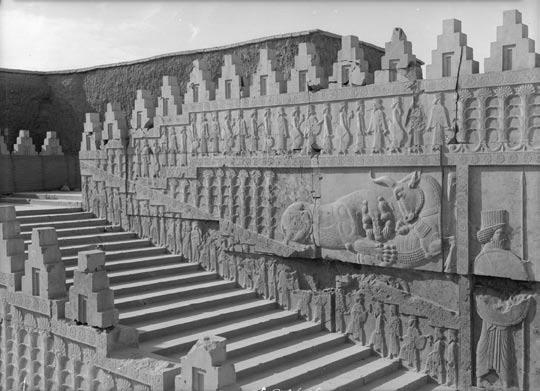
    Darius I (522–486 B.C.) began to build the imperial residence complex at Persepolis (modern Takht-i Jamshid, near Shiraz in southwestern Iran) and the work flourished under his son Xerxes (486–465 B.C.) and under succeeding Achaemenid kings. The additions, alterations, and rebuilding came to a brutal end when Alexander the Great conquered, looted, and burned the palace complex in 330/329 B.C. Even in ruins, the massive platform, lofty columns, sculptured walls, and staircases were imposing, and for many centuries they attracted the attention of visitors. Some early European travelers brought back souvenirs, and others made records. Carsten Niehbuhr’s precise dawings of the trilingual cuneiform inscriptions on the visible ruins at Persepolis, made at the end of the eighteenth century, became the basis for the first steps in deciphering the cuneiform scripts at the beginning of the nineteenth.

    But it was not until 1931 that an Oriental Institute expedition began to excavate what lay beneath these standing ruins. One entirely surprising discovery was a large group of clay tablets and fragments, proof that behind the splendid palaces and sculptured façades that were the setting for the court of the Great Kings stood an administrative apparatus that controlled movements of food, animals, and labor in the region around the palaces, the heartland of the Persians, and that apparatus relied on an information system that was as complex and sophisticated as any in the ancient world.

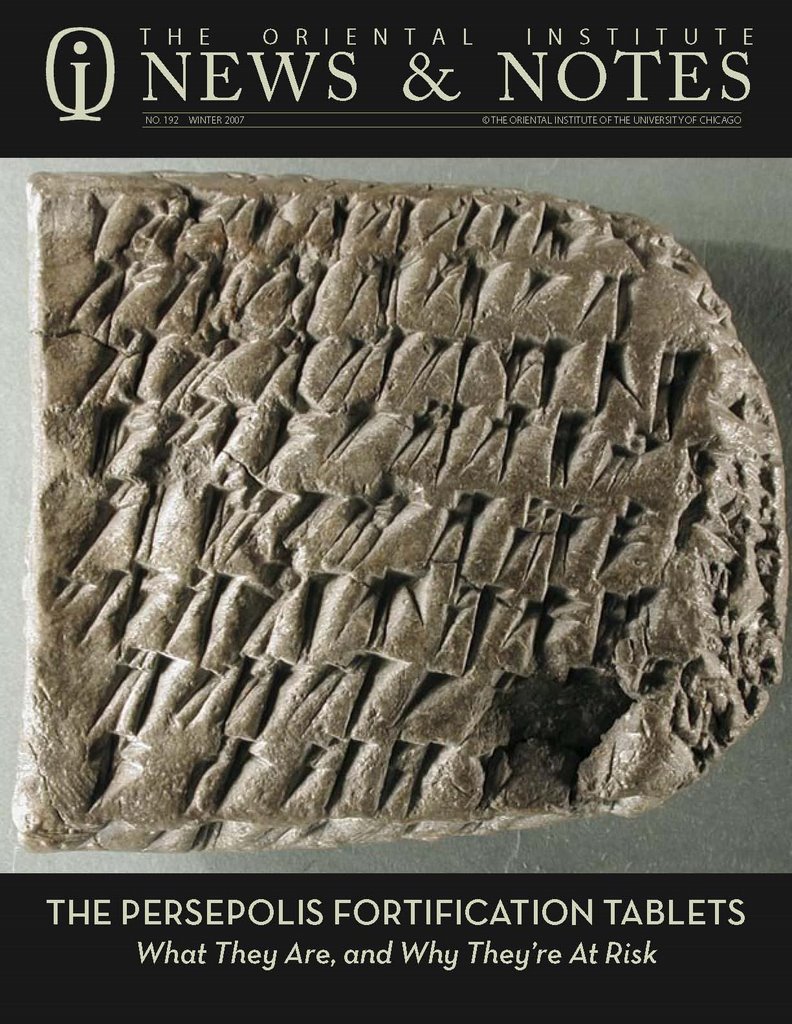
    The tablets were unearthed in 1933 near a bastion of the fortification wall that surrounded the great platform and the hillside above it. The findspot gave its name to the Persepolis Fortification tablets. There were as many as 15,000 to 30,000 or more tablets and fragments. Most (thousands of tablets and tens of thousands of fragments) were in the Elamite language in cuneiform script. A few (hundreds of tablets and hundreds of fragments) were in the Aramaic language and script. Most inscribed tablets had impressions of seals, and thousands of other similarly shaped pieces had only seal impressions, with no text at all. There were single tablets in the Akkadian language in cuneiform script, in Greek language and script, and in an Anatolian script perhaps representing the Phrygian language. It took years to determine that the whole group came from the middle of the reign of Darius I, 509–494 B.C.


    Above: Oblique aerial view of the Persepolis Terrace. OIM AE-560

    What Do They Tell Us About?

    The Fortification tablets came to Chicago in 1936, on loan for study. A team of scholars began work at once, but the vicissitudes of World War II and post-war professional circumstances shrank the team that had worked on the main body, the Elamite texts, to one man, Richard T. Hallock. Almost every part of Hallock’s task needed groundbreaking work, but the ground was new and hard. It was not until 1969 that Hallock published his exact, magisterial edition of 2,087 Elamite texts on Fortification tablets (Persepolis Fortification Tablets, OIP 92, usually abbreviated as PFT)


    Hallock’s book included transliterations and translations of the texts, a glossary of all known Achaemenid Elamite words, a sketch of Achaemenid Elamite grammar, a detailed analysis of the transactions and administrative systems that the texts recorded, and a key to the use of seals on the tablets that was the basis for analyzing the administration of the Persepolis region.

    As the implications of Hallock’s publication started to become clear, they had a profound effect on many ways of understanding the ancient Iranian past. Of course, the Persepolis Fortification archive was a very large corpus for the study of the latest phase of Elamite, a language known since the decipherments of the nineteenth century, but still scarcely understood, but the tablets had many other layers of information as well. The Elamite texts abound in transcriptions of Iranian names and titles, so they were also a new corpus for the study of Old Iranian languages, especially the Iranian of the Achaemenid court (otherwise represented only by a few inscriptions) and the terminology of production and administration (otherwise represented only by loanwords in other ancient languages). The texts were dated and sealed, so the tablets supplied a new corpus for the exact study of Elamite and Achaemenid Persian art in the “minor” form of glyptic, a form that reveals experiment and development in the minds and hands of individual masters in ways that grand buildings and relief carvings cannot. The texts depict a complex regional administration, so the archive was a basis for reinterpreting fragmentary administrative records from other regions of the Achaemenid Empire. The contents of the texts were narrow and even dull — food and drink — but the institution that kept the texts dealt with almost the whole gamut of imperial society that literallyfed at the king’s door, from lowly workers and less lowly craftsmen, to local officials, bureaucrats, and accountants, to official travelers coming to and from the court from the farthest reaches of the empire, to the king’s own family and in-laws. And by showing the Achaemenids no longer as illiterate barbarian rulers of more civilized subjects, but as successors to millennia of statecraft and administrative technique, the large sample of texts that Hallock published was the impetus for changing direction in modern studies of Achaemenid history. No treatment of the Persian Empire, its history, institutions, languages, or art, can omit the view of the imperial center and its connections afforded by the Elamite Fortification tablets.

    What Has Been Done?

    One reason that this impact was slow to emerge is that the real significance lies not in particular texts — there is no narrative, no description, and little drama to be seen in them — but in the complex web of connections among texts. The 2,087 documents that Hallock published represented just the beginning of the data points to be connected to this web. Before Hallock died in 1979, he transliterated and glossed 2,586 more Fortification texts, but he published only thirty-one of them. Transliterations of the rest were made available to researchers on various projects: they are cited from Hallock’s transcriptions in reference works on Elamite lexicon, historical geography, Old Iranian language and lexicon, and in many special studies.

    The Elamite texts were only one component of the whole archive. The tablets with texts in Aramaic — a language that was used throughout the Achaemenid Empire, from Egypt to Central Asia, not only for some regional administration, but also for interregional communication, became the responsibility of Raymond Bowman. He worked on them off and on for much of his life, and when he died (in the same year as Hallock), he left draft editions of about 500 Aramaic texts on Fortification tablets. This is another extraordinary linguistic and historical treasure-trove. We have other Achaemenid Aramaic ostraca and legal papyri, but when Bowman’s editions are revised and updated for modern publication, they will almost double the number of documents in Imperial Aramaic, as this form of the language is usually called. Equally important, when the links between the Aramaic and Elamite Fortification texts begin to become clear, this Imperial Aramaic corpus will be unique for its dense historical context, and it will add an entirely new dimension to the information web of the Elamite texts.

    Detail of the sculptured walls and grand staircase of the Persepolis palace complex. The Fortification tablets recorded the administrative structure of the Persian Empire

    Both the Elamite and the Aramaic tablets carry the impressions of seals, usually of one or two seals, sometimes more. These are the visible representation of the people and offices that operated the institution that kept the tablets. For the users of these documents, they brought both identity and authority to the written information.Hallock identified impressions of more than a thousand distinct seals on the tablets in PFT, and since 1979, Margaret Root (University of Michigan)and Mark Garrison (Trinity University)have worked on a three-part publication of these and all the other seal impressions. The Oriental Institute published the first part in 2001 (OIP 117). It reveals still another dimension of the information in the Fortification archive, not only an array of art and craft, but also a compendium of connections among individuals, offices, operations, and images.


    What Is Being Done?

    The work left by Hallock and Bowman remains to be finished, and the Oriental Institute has begun to bring it to completion in forms that were unheard of when the work started, using electronic tools. Since 1989, Charles E. Jones (former Research Archivist, Oriental Institute, now at the American School of Classical Studies in Athens) and I have collaborated in collating Hallock’s transcriptions of unpublished Fortification texts (abbreviated as PF-NN) and transcribing them to computer files. Since 1996, we have collaborated with Gene Gragg (Professor and former Director, Oriental Institute), and since 2001 with Sandra Schloen (programmer, Oriental Institute) on a prototype electronic publication of PF-NN 0001–0300 in the On-line Cultural Heritage Resource Environment (OCHRE), adapting programs and standards developed for electronic publication of the Chicago Hittite Dictionary. Since 2003, I have supervised students and volunteers who are making and editing digital pictures of Elamite Fortification tablets to link to electronic editions of the texts.

    Since 2006, Annalisa Azzoni (Vanderbilt University) has been revising and updating Bowman’s edition of Aramaic texts, and expanding it to include other such texts unknown to Bowman, also compiling the information in OCHRE in a form that will underlie an eventual publication. Elspeth Dusinberre (University of Colorado) has begun to work on the seal impressions on these Aramaic tablets, and in 2006, Garrison began a pilot project for analysis and publication of the sealed, uninscribed tablets — a large, entirely untouched corpus of thousands of documents, perhaps a sixth or more of the whole archive.


    In 2006, Lec Maj (Computer Research, Division of the Humanities, University of Chicago) and I received a grant from the University’s Advanced Technologies Initiative to investigate high-tech imaging systems that might be applicable to the Fortification material

    CT scanning, 3-D scanning, X-ray and other forms of imaging — not only to record the objects in as much detail as possible and as quickly as possible, but also to help with decisions about cleaning, conservation, and curation. Also in 2006, Gil Stein (Director, Oriental Institute), myself, and others of the growing Persepolis team joined Bruce Zuckerman (University of Southern California) acknowledged as the leading expert on making images of West Semitic documents — in designing a project to record the Aramaic Persepolis tablets and the sealed, uninscribed Persepolis tablets, using both very high quality conventional digital imaging and a process called Polynomial Texture Mapping that allows the viewer to manipulate the apparent light source in images of seal impressions and other low-relief items.

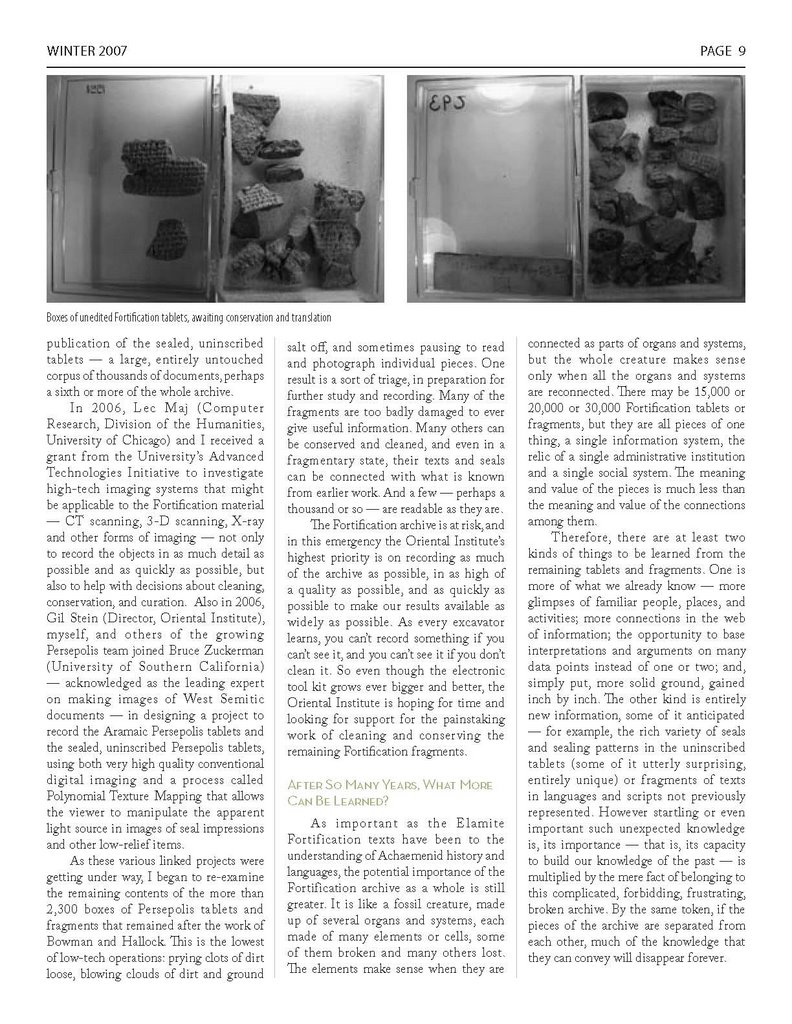
    As these various linked projects were getting under way, I began to re-examine the remaining contents of the more than 2,300 boxes of Persepolis tablets and fragments that remained after the work of Bowman and Hallock. This is the lowest of low-tech operations: prying clots of dirt loose, blowing clouds of dirt and ground salt off, and sometimes pausing to read and photograph individual pieces. One result is a sort of triage, in preparation for further study and recording. Many of the fragments are too badly damaged to ever give useful information. Many others can be conserved and cleaned, and even in a fragmentary state, their texts and seals can be connected with what is known from earlier work. And a few — perhaps a thousand or so — are readable as they are.

    The Fortification archive is at risk, and in this emergency the Oriental Institute’s highest priority is on recording as much of the archive as possible, in as high of a quality as possible, and as quickly as possible to make our results available as widely as possible. As every excavator learns, you can’t record something if you can’t see it, and you can’t see it if you don’t clean it. So even though the electronic tool kit grows ever bigger and better, the Oriental Institute is hoping for time and looking for support for the painstaking work of cleaning and conserving the remaining Fortification fragments.


    As important as the Elamite Fortification texts have been to the understanding of Achaemenid history and languages, the potential importance of the Fortification archive as a whole is still greater. It is like a fossil creature, made up of several organs and systems, each made of many elements or cells, some of them broken and many others lost. The elements make sense when they are connected as parts of organs and systems, but the whole creature makes sense only when all the organs and systems are reconnected. There may be 15,000 or 20,000 or 30,000 Fortification tablets or fragments, but they are all pieces of one thing, a single information system, the relic of a single administrative institution and a single social system. The meaning and value of the pieces is much less than the meaning and value of the connections among them.

    Therefore, there are at least two kinds of things to be learned from the remaining tablets and fragments. One is more of what we already know — more glimpses of familiar people, places, and activities; more connections in the web of information; the opportunity to base interpretations and arguments on many data points instead of one or two; and, simply put, more solid ground, gained inch by inch. The other kind is entirely new information, some of it anticipated — for example, the rich variety of seals and sealing patterns in the uninscribed tablets (some of it utterly surprising, entirely unique) or fragments of texts in languages and scripts not previously represented. However startling or even important such unexpected knowledge is, its importance — that is, its capacity to build our knowledge of the past — is multiplied by the mere fact of belonging to this complicated, forbidding, frustrating, broken archive. By the same token, if the pieces of the archive are separated from each other, much of the knowledge that they can convey will disappear forever.

    [Following are the pages of these articles in the format in which they were originally published in The Oriental Institute News and Notes. The full issue is now online: 2007 Winter (#192)]


    A Heritage Threatened: The Persepolis Tablets Lawsuit and the Oriental Institute


    Gil J. Stein, Director, Oriental Institute

    [See also What are the Persepolis Fortification Tablets? by Matthew W. Stolper]

    The Persepolis Fortification texts have seen two firestorms. The first was the burning of the Persian capital by Alexander the Great in 329/330 B.C. After surviving this destruction, the tablets now face a second conflagration — a legal battle that could well lead to the dismemberment of this unique archive if it is seized, auctioned off piecemeal, and disappears into the holdings of private art collectors around the world. This latter threat is quite real and could lead to the loss of the single most important surviving source of information about the organization of the 2,500 year old Persian Empire of Cyrus, Darius, and Xerxes. If this actually happens, it would be a loss to science of unprecedented scale, and it would rob the Iranian people of one of the most important symbols of their cultural heritage and identity. But the tablets speak to concerns far beyond those of the Iranian people — in fact, this legacy of the Persian Empire foms a key part of the golden thread that links the ancient Near East, the Judeo-Christian traditions of the Bible, and the emergence of Greek and Western civilization. As such, the fate of these tablets should be of greatest concern to every thinking individual. The Oriental Institute and the University of Chicago are absolutely determined to protect the integrity of this remarkable archive as both a unique scholarly resource and as a touchstone of world cultural heritage. How did this dusty trove of unbaked clay cuneiform-impressed tablets become embroiled in controversy and threatened in this way?


    From Takht-i-Jamshid to Chicago: The Odyssey of the Persepolis Tablets

    As described so well by Professor Matthew Stolper in the accompanying article in this issue of News & Notes, one of the greatest accomplishments of the Oriental Institute is surely its excavations during the 1930s at Takht-i-Jamshid — ancient Persepolis, the 2,500 year old monumental capital of the Achaemenid Persian Empire. During the 1933 season of excavations, Ernst Herzfeld and his team from the Oriental Institute discovered a deposit containing tens of thousands of unbaked clay tablets and badly broken tablet fragments impressed with writing in a cuneiform script; the trove was found in one of the rooms of the northern Fortification wall surrounding the palaces, treasuries, and temples of Persepolis. The Persepolis tablets are tremendously important for two reasons. First, they are a unique resource for scholarship. Until their discovery, our main written sources for the Persian Empire were those written by foreigners — notably the Hebrew Bible and Greek sources such as Herodotus and historians of Alexander’s campaigns. These accounts,quite naturally, gave a partial and biased picture of the Persian Empire. A handful of monumental carved stone inscriptions by Darius and Xerxes at Bisitun and on the palace walls of Persepolis itself were the only real records written by the Persians. With the discovery of the Persepolis Fortification tablets, researchers were finally able to get an understanding of the everyday life and internal workings of the Achaemenid imperial organization, as described by the Persians themselves. The tablets also bear thousands of seal impressions. Since the archive is securely dated within a very narrow time range (from 509 to 494 B.C. in the reign of Darius I), this allows art historians to precisely date the use of specific art styles, while interpreting them as a related body of art aimed at presenting the official and unofficial ideologies and belief systems of the Achaemenid imperial elite.

    But the Persepolis tablets also have a very deep modern significance as irreplaceable items of cultural heritage for the people of Iran. Persepolis and the Persian Empire are the central symbols of Iranian cultural identity. The greatness of the Achaemenid Empire is deeplyengrained in Iranians’ very definition of who they are as a people and their important role in the history of civilization. To this day, names such as “Cyrus” or “Darius” are common in Iran, and every Iranian is aware of the significance of the site of Takht-i-Jamshid, as Persepolis is known in the Farsi language. The Persepolis texts, as the actual records of the government of the Persian king Darius, resonate for Iranians at a very profound level. In other words, these are items of cultural heritage as important as the crown jewels of England, or the original document of the Magna Carta, or the Western Wall in Jerusalem, or the Parthenon in Athens.

    It was therefore an extraordinary act of trust and international scholarly cooperation in 1936, when the Iranian government allowed the tablets to be brought to the Oriental Institute on a long-term loan for purposes of translation and analysis. The texts were recovered from the ground in an extremely fragile and often fragmentary state. The massive quantity, fragile physical condition, and the challenges of reading the texts have made their analysis and publication a difficult, long-term project that has extended for seventy years and is still far from completion. The vast majority of the tablets are written in a late dialect of Elamite, the oldest written language of Iran. This extremely difficult language can be read by only a tiny number of highly- trained researchers, perhaps no more than twenty or so throughout the world. It took decades before Oriental Institute scholar Richard Hallock was able to decipher the script effectively and publish the first set of about 2,000 tablets. The texts are the abbreviated records of the issuance of food rations to various functionaries in order to supply them as they traveled or worked on behalf of the Achaemenid imperial administration. This makes it extremely difficult to understand the contents of the texts, even if one can actually read the written words — one might compare it to the challenge of a person from another country trying to make sense of thousands of cash-register receipts from a supermarket. Would they know that the phrase “ ½ gal 2 pct” refers to “ one-half gallon of low-fat (2%) milk”? Professor Hallock famously summarized the difficulty of working with the Persepolis texts when he remarked “if you’re not confused, then you clearly don’t understand the problem.”

    Despite these challenges, by dint of sheer brilliance and persistence, Hallock and other scholars slowly started to crack the code of the Persepolis tablets, and as they did so, they revolutionized Achaemenid studies to give the world its first understanding of the Persian Empire in the actual words of the long-dead Persians themselves. Professor Matthew Stolper of the Oriental Institute now bears the primary responsibility for the analysis and translation of the tablets.

    Return of the Texts

    From the time of the tablets’ first arrival in Chicago, researchers at the Oriental Institute were keenly aware of the texts’ importance as the cultural heritage of the Iranian people, and of their scholarly responsibility not only to translate the tablets but also to ensure their return as loan objects back to Iran once their analysis and recording were complete. Professor George Cameron returned the first set of 179 tablets in 1948. A second shipment of more than 37,000 tablet f ragments followed in 1951. In May 2004, a team consisting of myself, Laura D’Alessandro, Head of Conservation, and William Harms from the University of Chicago News Office returned an additional 300 complete tablets to the National Museum in Tehran. At this point, by our best estimates, more than two thirds of the Persepolis Fortification texts have been returned to Iran.There now remain approximately 8,000 tablets and 11,000 poorlypreserved fragments of the unbaked clay tablets awaiting analysis at the Oriental Institute.


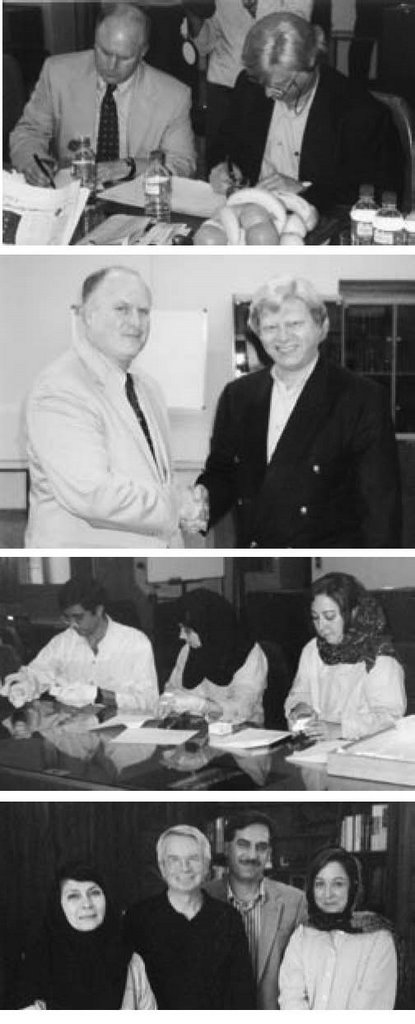
    Top to bottom: Gil J. Stein and Mohammad Beheshti, Director of the Iranian Cultural Heritage Organization, signing receipt for the tablets. Gil J. Stein and Mohammad Beheshti after signing the document. Sharokh Razmjou and Madame Zahra Jaffar-Mohammadi of the Iranian National Musem and the Oriental Institute’s Laura D’Alessandro inspecting the tablets after their return. Madame Zahra Jaffar-Mohammadi, William Harms, Director of the Iranian National Museum, Reza Kargar, and Laura D’Alessandro. Photo credits: top three William Harms, bottom Gil Stein.


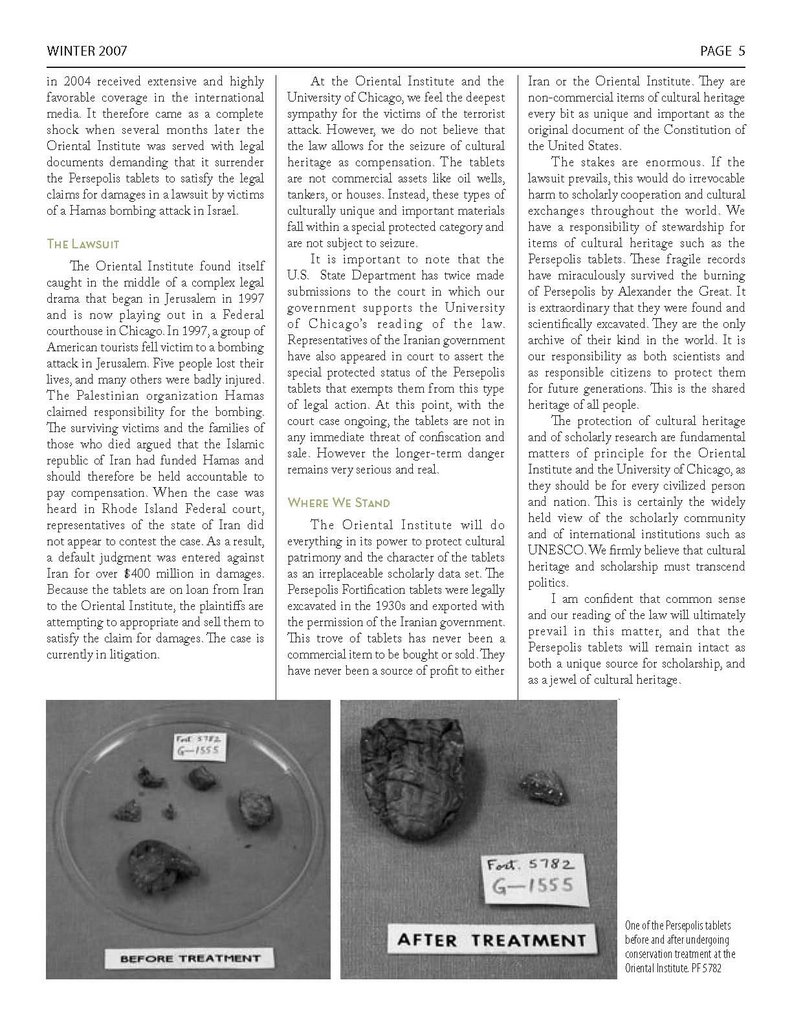
    The most recent return of loaned tablets in 2004 received extensive and highly favorable coverage in the international media. It therefore came as a complete shock when several months later the Oriental Institute was served with legal documents demanding that it surrender the Persepolis tablets to satisfy the legal claims for damages in a lawsuit by victims of a Hamas bombing attack in Israel.

    The Oriental Institute found itself caught in the middle of a complex legal drama that began in Jerusalem in 1997 and is now playing out in a Federal courthouse in Chicago. In 1997, a group of American tourists fell victim to a bombing attack in Jerusalem. Five people lost their lives, and many others were badly injured. The Palestinian organization Hamas claimed responsibility for the bombing. The surviving victims and the families of those who died argued that the Islamic republic of Iran had funded Hamas and should therefore be held accountable to pay compensation. When the case was heard in Rhode Island Federal court, representatives of the state of Iran did not appear to contest the case. As a result, a default judgment was entered against Iran for over $400 million in damages. Because the tablets are on loan from Iran to the Oriental Institute, the plaintiffs are attempting to appropriate and sell them to satisfy the claim for damages. The case is currently in litigation.

    At the Oriental Institute and the University of Chicago, we feel the deepest sympathy for the victims of the terrorist attack. However, we do not believe that the law allows for the seizure of cultural heritage as compensation. The tablets are not commercial assets like oil wells, tankers, or houses. Instead, these types of culturally unique and important materials fall within a special protected category and are not subject to seizure.

    It is important to note that the U.S. State Department has twice made submissions to the court in which our government supports the University o f Chic ago’s reading of the law. Representatives of the Iranian government have also appeared in court to assert the special protected status of the Persepolis tablets that exempts them from this type of legal action. At this point, with the court case ongoing, the tablets are not in any immediate threat of confiscation and sale. However the longer-term danger remains very serious and real.

    Where We Stand

    The Oriental Institute will do everything in its power to protect cultural patrimony and the character of the tablets as an irreplaceable scholarly data set. The Persepolis Fortification tablets were legallyexcavated in the 1930s and exported with the permission of the Iranian government. This trove of tablets has never been a commercial item to be bought or sold. They have never been a source of profit to either Iran or the Oriental Institute. They are non-commercial items of cultural heritage every bit as unique and important as the original document of the Constitution of the United States. The stakes are enormous. If the lawsuit prevails, this would do irrevocable harm to scholarly cooperation and cultural exchanges throughout the world. We have a responsibility of stewardship for items of cultural heritage such as the Persepolis tablets. These fragile records have miraculously survived the burning of Persepolis by Alexander the Great. It is extraordinary that they were found and scientifically excavated. They are the only archive of their kind in the world. It is our responsibility as both scientists and as responsible citizens to protect them for future generations. This is the shared heritage of all people.

    The protection of cultural heritage and of scholarly research are fundamental matters of principle for the Oriental Institute and the University of Chicago, as they should be for every civilized person and nation. This is certainly the widelyheld view of the scholarly community and of international institutions such as UNESCO. We firmly believe that cultural heritage and scholarship must transcend politics.

    I am confident that common sense and our reading of the law will ultimately prevail in this matter, and that the Persepolis tablets will remain intact as both a unique source for scholarship, and as a jewel of cultural heritage.

    [Following are the pages of these articles in the format in which they were originally published in The Oriental Institute News and Notes. The full issue is now online: 2007 Winter (#192)]


    Monday, December 11, 2006

    Chicago's Persian heritage crisis

    Chicago's Persian heritage crisis "(تاراج سرمايه باستانی ايران در شيکاگو in Persian) refers to a threat to seize invaluable Persian antiquities kept at the University of Chicago by the United States federal courts and also a threat to numerous other Persian antiquities kept in the Field museum in Chicago. It has been seen by Iranians as an example for the hostility of United States federal court system toward Iranian people and Persian heritage" Article in Wikipedia.

    Wednesday, December 06, 2006

    Biographical Sketch of David Malcolm Lewis

    LEWIS, David Malcolm, (b. London, UK, 7.6.1928; d. Oxford, UK, 12.7.1994), distinguished historian and epigrapher of Greece in the fifth and fourth century BCE and, by extension, of the Achaemenid empire, by Amelie Kuhrt in Encyclopaedia Iranica.

    Tuesday, November 21, 2006

    Skjaervo's Introduction to Old Persian

    Not directly related to the Persepolis Fortification Archive (but more directly related than it was a few weeks ago), is P. Oktor Skjaervo, Introduction to Old Persian, one of six guides to Iranian languages and religions he has made publicly available at Iranian Studies at Harvard University.

    Thursday, November 16, 2006

    Biographical Sketch of Ernst Emil Herzfeld

    HERZFELD, ERNST EMIL, (1879-1948), archeologist, philologist, and polyhistor, one of the towering figures in ancient Near Eastern and Iranian studies during the first half of the 20th century. To him we owe many decisive contributions to Islamic, Sasanian, and Prehistoric archeology and history of Iran, Iraq, and Syria. He was the first professor for Near Eastern archeology in the world and instrumental in drafting and issuing the first Persian law of antiquities, by Stefan R. Hauser, David Stronach, Hubertus von Gall, Prods Oktor Skjœrvø, and Josef Wiesehöfer in Encyclopaedia Iranica.


    Two links added (November 25 2006):

    Read the book: Ernst Herzfeld and the Development of Near Eastern Studies 1900-1950.

    Look at the website of the Ernst-Herzfeld-Gesellschaft.

    Read Milestones in the Development of Achaemenid Historiography in the Times of Ernst Herzfeld (1879-1948), by Pierre Briant

    Biographical Sketch of George Glenn Cameron

    CAMERON, GEORGE GLENN , philologist and his­torian, b. 30 July 1905 in Washington, Pennsylvania, d. 14 September 1979 in Ann Arbor, Michigan. Cameron received the A.B. degree from Muskingum College in New Concord, Ohio, in 1927. After two years as a high­-school teacher and principal he took A.M. and Ph.D. degrees from The University of Chicago in 1930 and 1932 respectively, by Gernot L. Windfuhr in Encyclopaedia Iranica.

    A digital version of George G. Cameron 1905-1979, by Matthew W. Stolper, in The Biblical Archaeologist, Vol. 43, No. 3 (Summer, 1980), pp. 183-189, is available at JSTOR to those whose institutions provide access.

    Tuesday, November 14, 2006

    Musée achéménide virtuel et interactif (Mavi)

    Musée achéménide virtuel et interactif (Mavi)

    "Un vaste "Musée achéménide virtuel et interactif" (Mavi) de plus de 8.000 pièces, consacré au patrimoine de l'Empire Perse de Cyrus à Alexandre le Grand, est désormais consultable sur internet à l'initiative d'un professeur du Collège de France, Pierre Briant."

    An extraordinary new resources, Mavi includes (among many other things) illustrations of the published seal impressions from Persepolis Fortification Tablets.

    A brochure describing MAVI in detail is available in French and in English.

    Mavi is the Site du mois for November at www.jesuites.com!

    Monday, November 13, 2006

    Biographical Sketch of Richard Treadwell Hallock

    HALLOCK, RICHARD TREADWELL (b. Passaic, New Jersey, 5 April 1906, d. Chicago, 20 November 1980), Elamitologist and Assyriologist, whose magnum opus, Persepolis Fortification Tablets, transformed the study of the languages and history of Achaemenid Persia, by Charles E. Jones and Matthew W. Stolper in Encyclopaedia Iranica.